Mica powder for paint represents a fascinating intersection of mineral science and artistic expression. Its ability to impart shimmer, pearlescence, and enhanced durability to paints has made it a staple in industries ranging from automotive to cosmetics. Understanding the nuances of mica powder – its types, processing, and application – is crucial for achieving optimal results and exploring its full potential.
Globally, the demand for specialized coatings and paints is steadily increasing, driven by factors like infrastructure development, consumer preferences for aesthetically pleasing products, and stringent performance requirements. Mica powder for paint caters directly to this demand by offering unique visual effects and functional benefits that traditional pigments often cannot replicate. This makes it a significant player in the global pigments market, influencing trends in color technology and material science.
Furthermore, advancements in mica processing techniques and the development of synthetic mica are opening up new possibilities for tailoring properties like particle size, shape, and refractive index. This allows paint manufacturers to create highly customized formulations, responding to specific customer needs and pushing the boundaries of paint performance. It’s a versatile material with a continuously evolving role.
The Foundation of Shimmer: Understanding Mica Powder for Paint
Mica powder for paint isn’t simply a cosmetic additive; it’s a functional ingredient that dramatically alters the physical and aesthetic properties of coatings. Derived from naturally occurring silicate minerals, mica boasts a unique layered structure that provides exceptional reflectivity and interference effects. This is why paints containing mica powder exhibit a distinctive shimmer or pearlescent finish.
The versatility of mica powder extends beyond visual appeal. Its platy structure enhances paint film durability, improves resistance to weathering, and even contributes to corrosion protection. Selecting the appropriate grade of mica powder – based on particle size, shape, and surface treatment – is critical to achieving the desired performance characteristics in the final paint product.
Global Significance and Market Dynamics
The global market for pigments, including mica powder for paint, is substantial and continually expanding. According to industry reports, the pigment market is valued in the billions of dollars, with Asia-Pacific representing the largest and fastest-growing region due to rapid industrialization and increasing construction activities. Mica powder plays a key role in meeting the demand for high-performance coatings in this region and beyond.
However, the mica industry also faces challenges, particularly concerning ethical sourcing and sustainability. Concerns around child labor in some mica mining regions have prompted increased scrutiny and a push for responsible supply chains. Transparency and traceability are becoming paramount, driving the adoption of certification schemes and collaborations between manufacturers and NGOs. mica powder for paint suppliers are increasingly focusing on these issues.
Furthermore, the shift towards water-based paints and eco-friendly coatings is influencing mica powder development. Manufacturers are exploring innovative surface treatments and formulations to ensure compatibility with these environmentally conscious paints without compromising performance or aesthetic qualities.
Defining Mica Powder for Paint: Composition & Types
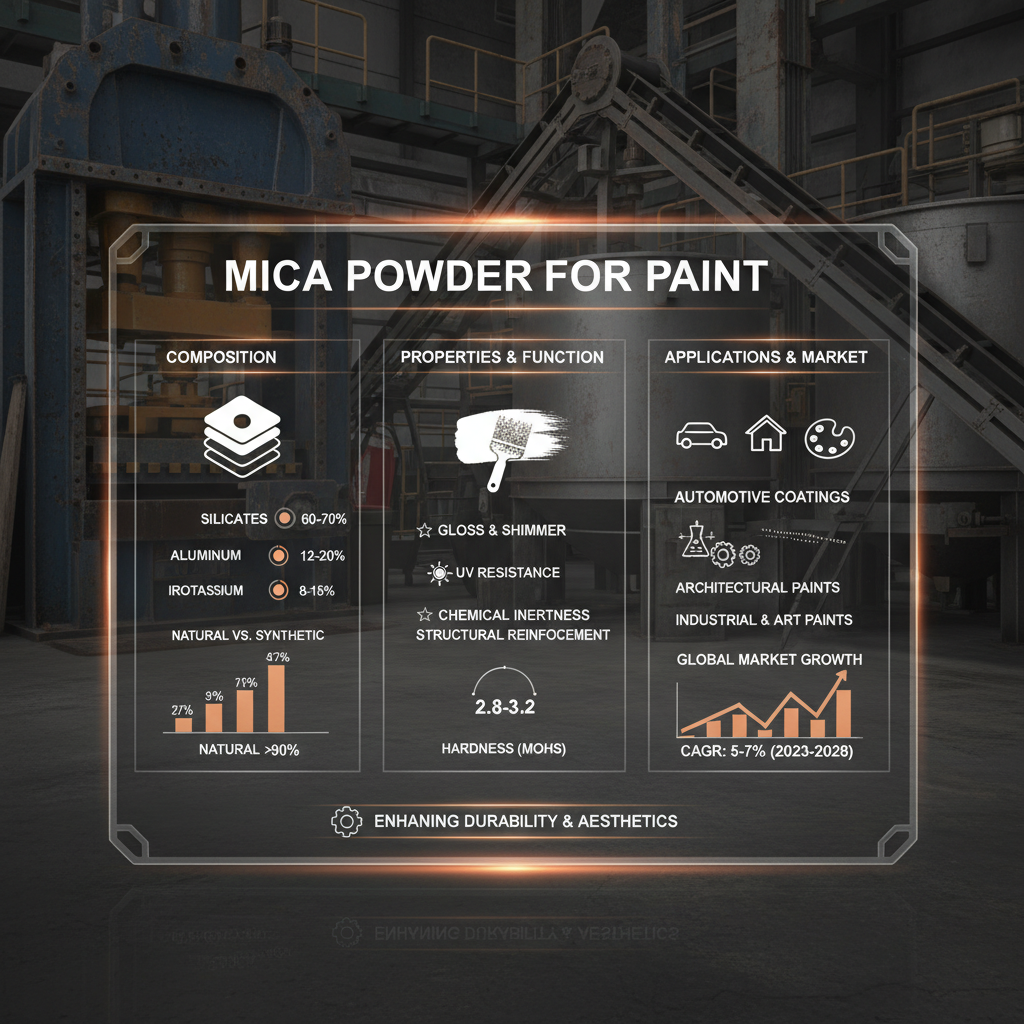
At its core, mica powder for paint is composed of silicate minerals, primarily muscovite, phlogopite, and biotite. These minerals are characterized by their layered structure, allowing them to split into thin, flexible flakes. These flakes are then processed – ground, milled, and often coated – to achieve specific particle sizes and optical properties.
The type of mica used significantly impacts the final product. Muscovite mica offers excellent clarity and high reflectivity, making it ideal for pearlescent effects. Phlogopite mica, with its lower iron content, exhibits superior heat resistance and chemical stability. Biotite mica, containing iron and magnesium, imparts a darker, earthier tone to paints. Synthetic mica, often produced from fluorophlogopite, provides consistent quality and tailored properties.
Surface treatments are also crucial. Coating mica flakes with titanium dioxide or iron oxide modifies their optical properties, creating a wider range of colors and effects. Treatments with silanes or other coupling agents enhance dispersion and compatibility with different paint binders. These treatments determine the final characteristics of the mica powder for paint used.
Key Characteristics and Performance Attributes
The effectiveness of mica powder for paint hinges on several key characteristics. Particle size is arguably the most important, influencing the paint's opacity, texture, and shimmering effect. Finer particles produce smoother, more translucent finishes, while coarser particles create a more pronounced sparkle. Beyond size, particle shape – whether flaky or spherical – affects light scattering and overall appearance.
Other critical attributes include refractive index, which determines the intensity of the shimmer, and chemical inertness, ensuring compatibility with paint binders and other additives. Mica’s inherent properties also contribute to paint durability, enhancing resistance to UV degradation, abrasion, and corrosion.
Performance Attributes of Different Mica Powder Processing Methods
Diverse Applications Across Industries
The applications of mica powder for paint are remarkably diverse. In the automotive industry, it’s used in base coats and clear coats to create metallic and pearlescent finishes that enhance vehicle aesthetics and protect against UV damage. The construction sector utilizes mica-containing paints for exterior walls, providing both visual appeal and long-lasting durability.
The cosmetic industry also heavily relies on mica, using it in a wide range of products like eyeshadows, lipsticks, and foundations to create shimmering effects and improve texture. Furthermore, mica powder finds applications in plastic coatings, printing inks, and even specialty coatings for aerospace applications, where its heat resistance and chemical inertness are highly valued.
Advantages of Using Mica Powder in Paint Formulations
Integrating mica powder for paint into formulations delivers a multitude of advantages. Primarily, it enhances aesthetic appeal, enabling the creation of vibrant, shimmering, and pearlescent finishes that differentiate products in the market. Beyond visual enhancements, mica improves paint film durability, increasing resistance to weathering, abrasion, and UV degradation.
Moreover, mica’s platy structure acts as a barrier, reducing permeability to moisture and corrosive agents. This enhances the protective properties of the paint, extending the lifespan of the coated surface. Finally, mica powder can contribute to cost efficiency by reducing the need for more expensive pigments while still achieving desired color and performance characteristics.
Future Trends and Innovations in Mica Powder Technology
The future of mica powder for paint is driven by innovation and sustainability. Research is underway to develop new surface treatments that enhance compatibility with water-based and bio-based paint formulations, reducing the environmental impact of coatings. The use of nanotechnology to create ultra-fine mica particles with enhanced optical properties is also gaining momentum.
Furthermore, advancements in mica mining and processing techniques are focused on improving efficiency and ensuring ethical sourcing. Blockchain technology is being explored to enhance transparency and traceability throughout the supply chain, addressing concerns about responsible sourcing. This will ensure the continued use of mica powder for paint remains sustainable and ethical.
The integration of digital printing technologies with mica-containing inks promises to enable customized paint designs and on-demand production, further expanding the versatility of this versatile material.
FAQS
Natural mica is mined from the earth and comes in varying qualities, while synthetic mica (often fluorophlogopite) is lab-created for consistent purity and properties. Synthetic mica generally offers better color consistency, particle size control, and a lower presence of impurities, making it ideal for demanding applications requiring precise performance. Natural mica is often more cost-effective for less critical uses.
Particle size is a crucial factor. Larger mica particles create a noticeable sparkle or glitter effect, while smaller particles result in a more subtle shimmer or pearlescence. Fine particles also contribute to smoother paint films and enhanced transparency. Selecting the appropriate particle size depends on the desired aesthetic and functional properties of the paint.
Mica itself is a naturally occurring mineral, but its mining can have environmental and social impacts. Responsible sourcing and ethical mining practices are vital. Synthetic mica offers a more sustainable alternative, and manufacturers are increasingly focusing on eco-friendly surface treatments and formulations to minimize the environmental footprint of mica-containing paints.
Mica powder is generally compatible with a wide range of paint binders, including acrylics, alkyds, epoxies, and polyurethanes. However, proper surface treatment is crucial to ensure good dispersion and adhesion. Silane coupling agents are often used to improve compatibility between mica and the binder, enhancing paint performance and durability.
Settling can be minimized by using a high-quality dispersing agent during paint formulation. Proper mixing and agitation during production and storage are also essential. Maintaining a consistent viscosity can help suspend the mica particles and prevent them from settling. Regular quality control checks during storage are recommended.
While generally considered safe, mica powder can be an irritant to the eyes and respiratory system. It’s recommended to wear safety glasses, a dust mask, and gloves when handling the powder. Ensure adequate ventilation in the work area and avoid inhaling the dust. Follow the manufacturer's safety data sheet (SDS) for detailed guidance.
Conclusion
In conclusion, mica powder for paint is a remarkably versatile material that significantly enhances the aesthetic and functional properties of coatings. From its ability to create captivating shimmering effects to its contribution to paint durability and UV protection, mica powder continues to play a vital role in a wide range of industries. Embracing responsible sourcing practices and investing in innovative technologies will ensure the continued sustainability and relevance of this valuable ingredient.
Looking ahead, the future of mica powder lies in tailoring its properties to meet the evolving demands of the coatings industry, particularly in the areas of environmentally friendly formulations and high-performance applications. Further research into nanotechnology and surface treatments will unlock new possibilities, solidifying mica powder’s position as a cornerstone of color technology. For high-quality mica powder and expert guidance, visit our website: www.kehuimica.com.